Luke 22-34
The Speech on the Areopagus
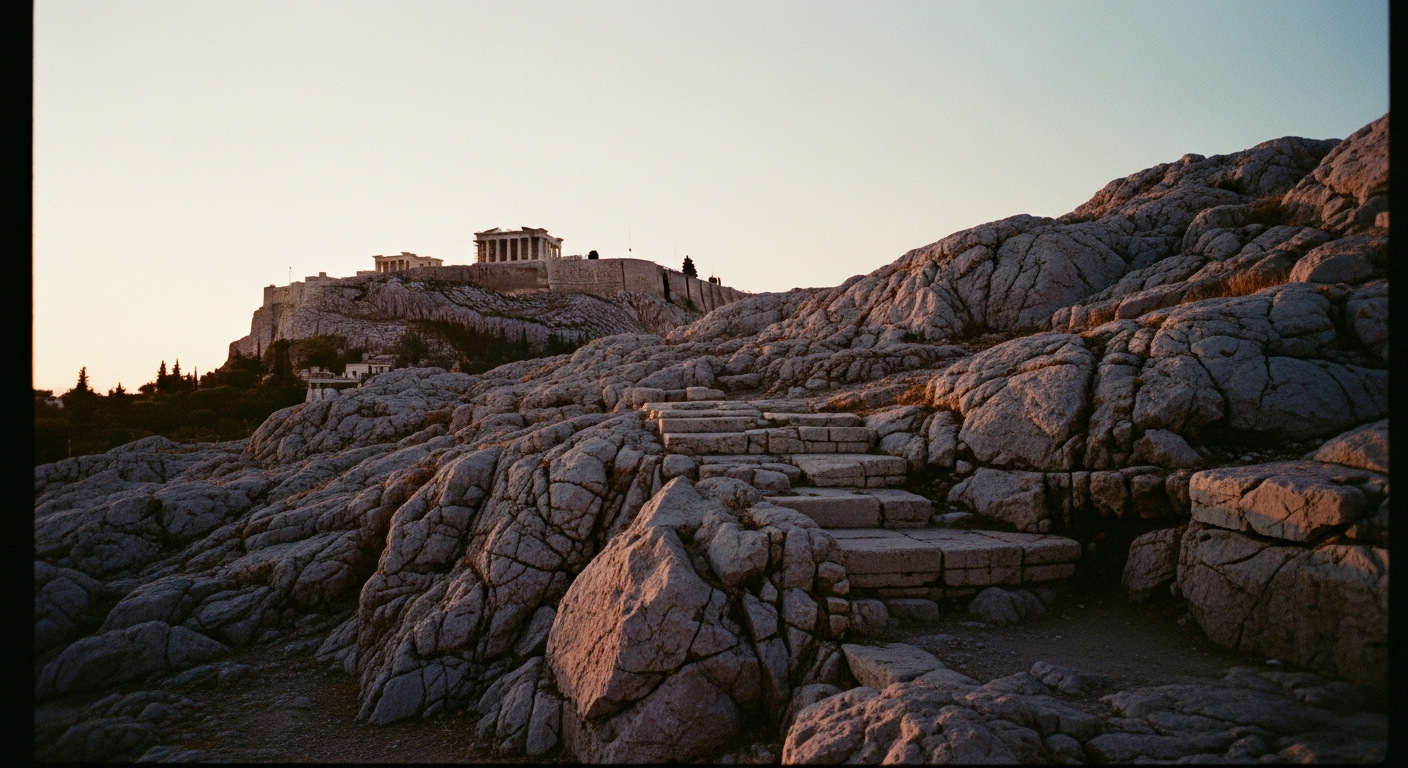
So Paul stood up there in the middle of the council, and began. "Men of Athens, everywhere I look in this city, I see how seriously you take the godsTexthow seriously you take the godsThe Greek word here can be read two ways — "superstitious," or "genuinely religious, serious about the divine." Older translations often chose the insult. But Paul is opening a speech by the rules of ancient oratory, and such an opening is built to win the audience's goodwill — it does not begin with a slap. The sense is the generous one: you take the divine with great seriousness. We translate what Paul is doing: he honors his hearers' search before he carries it further., and how thoroughly the divine has been worked into the very texture of your common life.
For as I walked through your city and looked carefully at the things you worship, I came at last upon an altar with these words cut into its stone: to an unknown godCultureTo an unknown godAthenian devotion covered every angle. The travel-writer Pausanias describes altars "to unknown gods"; similar ones are attested elsewhere. The logic was protective: lest a god you have failed to honor turn against you, you build it an altar in advance. Paul takes up that gesture — and sharpens it, turning the many unknown gods into a single one. He does not mock the altar. He takes seriously the search inside it, and claims: what you sense without being able to name it, that I can name.. What you worship, then, without knowing what it is: that is what I have come to tell you.
The God who made the world and everything in it — the Lord of heaven and earth — does not live in temples built by human hands, nor is he tended by human hands, as though he stood in need of anything; he himself gives to every living thing its life, its breath, everything it has. From oneTextFrom oneThe Greek manuscripts diverge here. The oldest read "from one"; many others read "from one blood." Both say the same decisive thing: every people descends from a single source, and no nation stands above another. The familiar English smoothing "from one man" is in no Greek manuscript at all. The verse has a bitter American history. Abolitionists read it straight — "all of one blood" — as the scriptural ground for human equality. On the other side, defenders of slavery answered with their own exegesis: Thornton Stringfellow's \em Scriptural and Statistical Views in Favor of Slavery\em* (1856), distributed across the South in the years before the war, set the template, and a long lineage of segregation-era prooftexters drew on the same maneuver — preserving the verse's words while inserting a hierarchy of peoples that the verse itself refuses. The text knows no ranking of peoples; the readers ranked them anyway. he made every people of the earth, and spread them across the whole face of it; he set the times appointed for them, and the boundaries of the lands in which they live, all of it so that they would seek him, reach out for him, the way a person feels for something in the dark, and perhaps in the end find him. And yet he is not far from any one of usLifenot far from any one of usThis is the line of the chapter for the reader who is not, by their own reckoning, "arrived." Paul is not saying that the seekers among his audience are at the doorstep, almost-but-not-yet; he is saying that what they have been reaching for — by touch, in the half-light, without certainty — has never been at any real distance. The mode of search the verse honors is tactile, not analytical: not what one has worked out, but what one feels for in the dark. If you do not know what you believe, the verse speaks about you, not against you. For those further along, the verse opens a contemplative thread that runs from the desert fathers through John of the Cross to the apophatic strand in modern theology: the God who is sought tactilely is the God whose nearness is felt before it is known. A practice the early Jesuits formalized in the examen, and Quakers in silent waiting, is built on exactly the disposition the verse names. The Berean reading habit from v. 11 deepens here into a longer arc: the same patience extended to one's own interior. And it lands beyond the personal — workplaces, friendships, civic life all run on what is reached for in the half-light long before it is articulated. This week, set aside thirty seconds at the same hour each day in which you do not try to settle the question — let it stand, and let yourself be near it. And say out loud, to one person, the thing you would normally keep to yourself.. For in him we live, in him we move, in him we are, as some of your own poets have said: We too are his childrenContextWe too are his childrenThe line is a quotation — from a poem by the Greek writer Aratus, who, like Paul, came from Cilicia. The earlier phrase, "in him we live and move," also had a ring that Stoic listeners would have recognized. What is remarkable is what Paul does with it: a Jewish messenger quotes pagan poetry, not to refute it but to agree with it. Greek wisdom, at its best, has touched something true; Paul takes it up and carries it forward. It is a generosity that later Christian argument too often lost..
And if indeed we are his children, then we cannot imagine that the divine in any way resembles gold, or silver, or stone, an image shaped by human craft, human imagination. God has let the times of not-knowingContexttimes of not-knowing"Not-knowing" can sound dismissive — as if everything before faith were mere darkness. That is not the sense. Paul is speaking to an educated audience in the intellectual capital of the ancient world; the "not-knowing" he names is the religious confusion of that confident elite — the city of countless altars that still had to dedicate one to a god it could not name. It is not a blanket verdict on every non-Christian culture. Where the sentence was later used to write off other religions as plain darkness, that was a misuse of the text. pass. But now he calls on everyone, everywhere, to turn, to repent. For he has set a day on which he will judge the world, and judge it justly, through a man he has appointed; and the proof he has given, to all, is this: he raised that man from the deadDifficulthe raised that man from the deadThis is where the speech breaks — then and now. A resurrection of the dead: for a modern, skeptical reader, this is the place to get off. — The Christian tradition does not read this line as a naive boast, but as the hinge everything turns on. Paul does not argue the resurrection into being from first principles; he reports an event — something he says happened, attested by people who staked their lives on it. If it is true, it is not a pious ornament but the reason this movement exists at all: death, which had the last word for the old Athenians, does not have it here. The earliest creed Paul cites (1 Corinthians 15:3–8) lists named witnesses; the founding charter of the very court Paul is addressing had ruled a resurrection of the dead explicitly out, and that is precisely the ruling the speech reverses. That is a serious reading, not a credulous one. — If the step to a historical event is too far, the text still says something readable as image: that a justice which counts is not handed down by the powerful but by one whom the powerful killed — and that violence does not get the last word. The resurrection, on this reading, is the sentence by which the world's verdict on Jesus is overturned. — And for the reader for whom even that is too far: the comparative study of religion notes that ancient near-eastern myths of dying-and-rising deities (Osiris, Dumuzi, Adonis) circulate as seasonal cycles tied to vegetation and the agricultural year. The New Testament's claim is structurally different — a particular man, named, in a particular week, with named witnesses — but the comparative frame is where skeptical scholarship locates the passage, and one can read it that way without leaving the page. — What all the readings share: the Athenians themselves split at exactly this point. Some laughed. Some put it off. You are in good company if you hesitate. The question the text leaves open is not whether you must believe it all at once, but how far you are willing to go.."
At the words "raised from the dead," the meeting broke up. Some of them laughed out loud. Others said, "We'll hear you on this another time." And Paul left the council.
But some went with him and believed: Dionysius, a member of the council itself; a woman named DamarisTexta woman named DamarisDamaris is the only woman named among the converts at Athens — and one of the very few women anywhere in the New Testament to appear in a setting this learned and this public. For a long time it was assumed that a woman in such a place could only have been a courtesan. Recent scholarship — Ivoni Richter Reimer among others — has set that reading aside: more likely she was herself educated in philosophy, since the Epicurean and Pythagorean schools admitted women. One old family of manuscripts cut her name out entirely; the same tendency quietly weakens the standing of women elsewhere in Acts. Luke names her, equal to Dionysius. So do we.; and others besides.