Luke 1-12
The Empty Tomb
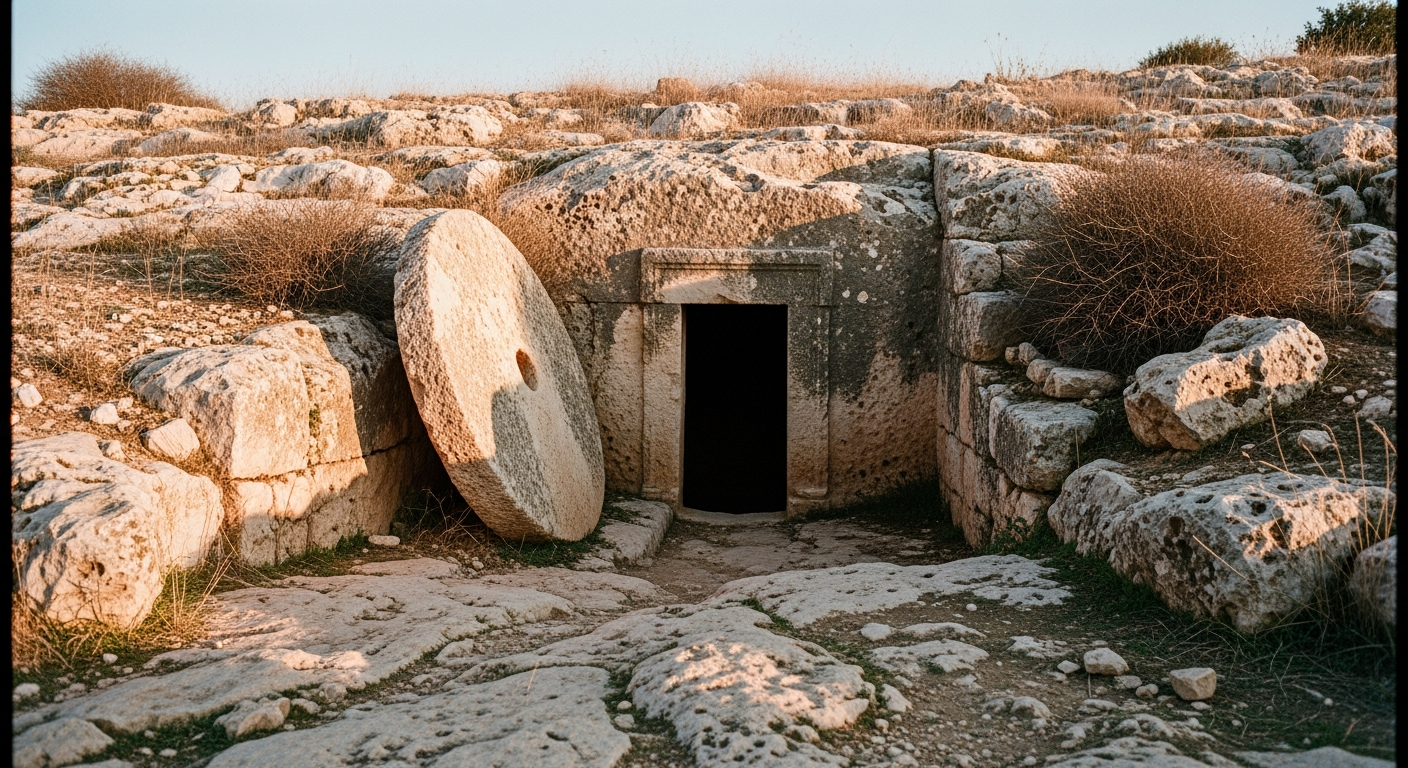
At the deep edge of dawnCultureat the deep edge of dawnLuke's phrase ὄρθρου βαθέως ("deep dawn") places the resurrection at the precise hour Scripture associates with divine action: God looked down on Egypt at dawn (Exodus 14:24), the angel struck the Assyrian camp before morning (2 Kings 19:35), and "joy comes in the morning" (Psalm 30:5). The women arrive earlier than Mark's "after sunrise" — Luke's precision signals independence from Mark and underscores the liminal, divine-action quality of the hour., on the first day of the week, the women came to the tomb carrying what they had prepared — the spices for his body. The stone had been rolled away. They went in. The body of the Lord JesusTextof the Lord JesusThe phrase "of the Lord Jesus" is absent from Codex Bezae (D) and some Old Latin manuscripts — one of the so-called "Western non-interpolations." The earliest papyrus witness, P75 (c. 175–225 CE), includes it. The phrase is characteristically Lukan in style and is retained in UBS5. was gone.
They stood there, at a loss. Then two menTexttwo menLuke says "two men" (ἄνδρες δύο), not "angels" — a deliberate reticence. Their dazzling clothing (the verb ἀστράπτω, "to flash like lightning," is used of the transfiguration garments in 9:29) marks them as heavenly beings without Luke using the word. The doubling may echo the legal requirement of two witnesses (Deuteronomy 19:15): the resurrection is attested by sufficient testimony. were standing beside them, their clothes blazing like lightningDifficultclothes blazing like lightningAngelic beings — figures in dazzling clothes delivering messages from God — are among the hardest elements for modern readers. Three frames: (1) The literary reading sees these as a biblical convention for divine communication, not unlike a narrator's aside: the story signals "God is speaking now." (2) The phenomenological reading takes the experience seriously on its own terms: something happened to these women that they described using the only categories available — luminous figures delivering a message. (3) The theological reading holds that God communicates through agents, and these were real encounters with real beings, even if their nature lies beyond our categories. What is striking is Luke's restraint: he does not say "angels." He says "two men" — and lets the blazing clothes do the work. The text refuses to over-explain what it cannot fully describe.. The women dropped their faces to the ground. "Why do you search for the Living OneContextthe Living One"The Living One" (ὁ ζῶν) is not merely descriptive — it is a divine title. Daniel 6:20 addresses God as "the living God"; Revelation 1:18 has the risen Christ say, "I am the Living One; I was dead, and now look, I am alive for ever and ever." The angelic question is a near-rebuke: if Jesus is the Living One, the tomb was never his proper location. among the dead?" the men said.
"He is not hereDifficultHe is not hereThe phrase "He is not here, but was raised" is absent from Codex Bezae and some Old Latin manuscripts, but present in P75 (c. 175–225 CE), Vaticanus, and Sinaiticus. The earliest evidence decisively supports the longer reading. The Western tradition's omission of the explicit resurrection announcement may reflect second-century theological caution rather than an older text.. He was raisedDifficultHe was raisedThe bodily resurrection of a dead person is the central claim of Christianity — and the one modern readers find hardest to accept. Several frameworks for thinking about it: (1) The naturalistic view holds that the disciples experienced grief visions or hallucinations. Against this: hallucinations are individual, not shared; they do not produce empty tombs; and the earliest Christians distinguished resurrection from ghost appearances (as Luke 24:37–39 explicitly does). (2) The mythological view reads the resurrection as a symbolic narrative expressing the ongoing significance of Jesus. Against this: Paul's creed in 1 Corinthians 15:3–8 (dated to within five years of the crucifixion) lists specific witnesses including 500 people "most of whom are still alive" — an appeal to living testimony, not myth. (3) The historical-theological view holds that something happened to the body of Jesus that the earliest witnesses could describe only as "God raised him" — an event without precedent or analogy, but with real consequences in history. N.T. Wright argues that no combination of an empty tomb (which would produce only a missing-body mystery) and post-mortem appearances (which would produce only a ghost story) accounts for what actually emerged: the sudden, unshakable conviction that Jesus was bodily alive and that a new creation had begun. The text presents the resurrection not as a resuscitation (return to mortal life) but as transformation — a body that eats fish yet passes through locked doors.TextHe was raisedThe divine passive ἠγέρθη ("was raised") — not "he rose" (active) — signals that God is the agent: God raised Jesus from the dead. This is the standard resurrection language in Luke (24:34, 46) and Paul (1 Corinthians 15:4). The resurrection is divine vindication of the one unjustly condemned by human courts.. Remember — he told you this, back in Galilee: that the Son of Man had to be handed over to sinful men. Had to be crucified. And on the third day, rise."
Then they remembered. His words came back to them.
They returned from the tomb and told everything to the Eleven and to all the rest. It was Mary Magdalene who said these things, and JoannaCultureJoannaJoanna appears only in Luke (here and 8:3), where she is identified as the wife of Chuza, Herod Antipas's household manager — a woman with connections to the royal court. Her inclusion among the first witnesses suggests Luke had access to a source with ties to Herodian circles. The three named women represent different social locations: Mary Magdalene from Galilee, Joanna from the court, Mary the mother of James from the family circle. — whose husband ran Herod's household — and Mary the mother of James, and others with them. They told the apostles all of it.
But the apostles heard deliriumCulturedeliriumThe Greek word λῆρος is not merely "nonsense." It is a medical term used in ancient clinical literature for the incoherent babbling of a fever patient (4 Maccabees 5:11; Aristophanes; Josephus, Jewish War 3.405). The apostles do not simply doubt the women — they pathologize their testimony, diagnosing it as a symptom of mental disorder. Women's testimony was generally inadmissible in Jewish legal proceedings. Luke records this dismissal as the apostles' error, not as a normative teaching about women — the narrative will prove the women right and the apostles wrong.. They kept refusing to believeDifficultthey kept refusing to believeThe imperfect tense ἠπίστουν indicates sustained, ongoing refusal — not a momentary lapse of faith. Three approaches: (1) The historical-critical reading notes that the criterion of embarrassment strongly supports authenticity — no inventor of the resurrection story in a first-century context would choose women as primary witnesses and then record the male leadership dismissing them. (2) The theological reading sees divine irony — the most important news in history arrives through the least credible messengers by the standards of the day. (3) The social-justice reading notes that Luke records this as failure: the institutional center was wrong; the marginalized witnesses were right. The text vindicates the women. them.
Peter, though, got up. He ran to the tomb. He bent down and peered inside — nothing but the linen cloths, lying by themselves. He walked away, marveling at what had happened.
Additional Notes
-
Text Peter ... marveling expand_more
This verse is absent from Codex Bezae (D) and the Western tradition. P75 (c. 175–225 CE) includes it, and its vocabulary is distinctly Lukan rather than simply borrowed from John 20:3–10. Luke carefully distinguishes Peter's "marveling" (θαυμάζων) from faith (πιστεύω). The empty tomb produces reverent wonder — not yet belief. Faith awaits the encounter with the risen Jesus himself.