Luke 50-56
The Burial
Then — a surprise. A man named Joseph, from Arimathea, came forward. He was a member of the council — but he hadn't consentedTexta member of the council — but he hadn't consentedLuke uses the surprise particle ἰδοὺ to introduce Joseph — an insider who broke ranks. His description as ἀγαθὸς καὶ δίκαιος ("good and righteous") uses the same word (δίκαιος) just applied to Jesus in v.47, verbally linking the two men. His legal dissent — "he had not agreed to their decision and action" — is important: not all Sanhedrin members voted for condemnation. This detail counters any collective-guilt reading of the trial. to any of it. A good man. A righteous man. He had been waiting for the kingdom of God.
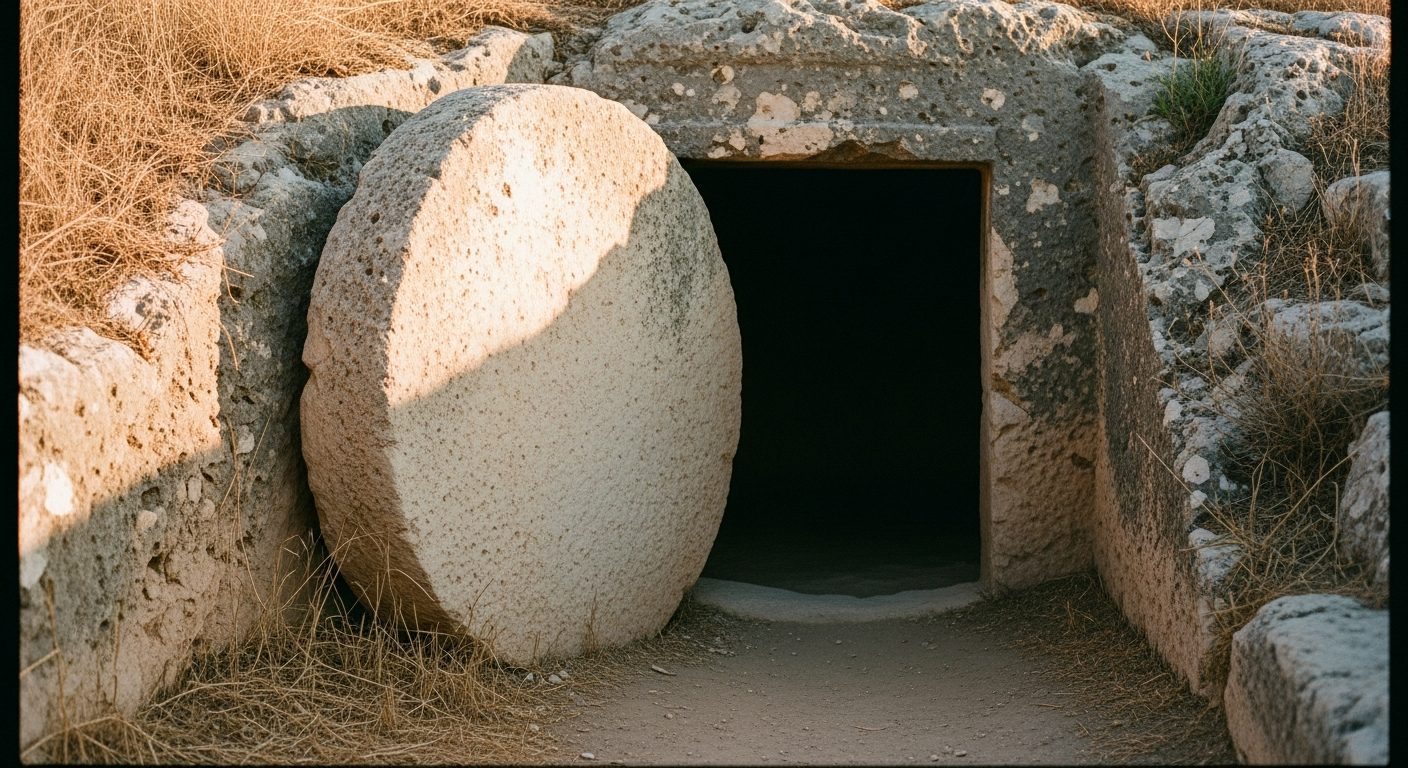
He went to Pilate and asked for the body. He took it down, wrapped it in linen cloth, and laid it in a rock-cut tomb where no one had ever been buriedCulturea rock-cut tomb where no one had ever been buriedRock-cut tombs were elite burial practice — hundreds have been identified from first-century Jerusalem. Joseph provides his own new tomb for a condemned criminal, an act of both piety and courage. Roman practice typically left crucified bodies on the cross as a deterrent or disposed of them in mass graves. Requesting the body of a crucified man from the Roman governor required both political influence and personal nerve..
It was Friday. The Sabbath was about to beginCultureFriday. The Sabbath was about to beginThe Greek παρασκευή ("Preparation Day") is the technical term for Friday — the day before the Sabbath, when all preparation for the day of rest had to be completed before sunset. The Sabbath began at sundown on Friday evening. The urgency of the burial — before sunset — is not about haste but about Torah observance..
The women who had followed Jesus from Galilee followed now too. They saw the tomb, saw how his body had been laid — noting everythingTextnoting everythingThe Greek verb ἐθεάσαντο is intensive — deliberate, careful observation, not a passing glance. Luke emphasizes the women's role as competent witnesses: they know exactly where the tomb is and exactly how the body was placed. This precise observation establishes the chain of testimony that makes the empty tomb discovery in 24:1-3 credible. When they return on Sunday morning, they will know what they are looking at — and what has changed..
Then they went home and prepared spices and ointments for the body. And on the Sabbath, they rested, as the law requiredContextthey rested, as the law requiredLuke's final word before the resurrection: these women are devout, Torah-observant Jews. Even in grief, even with an incomplete burial to finish, they honor the Sabbath commandment (Exodus 20:8-11). The earliest followers of Jesus did not break with Judaism — they observed the law. The spices are ready. The Sabbath holds. Something is about to happen — but not yet. The coiled tension of waiting is entirely contained in the phrase "as the law required.".
Additional Notes
-
Difficult Joseph of Arimathea expand_more
Joseph's existence is one of the most debated questions in passion scholarship. Arguments for historicity: (1) A member of the body that condemned Jesus asking for his body is an unlikely Christian invention — it serves no apologetic purpose and complicates the narrative. (2) The name "Arimathea" is not otherwise significant in Christian geography, suggesting it comes from memory, not symbolism. (3) All four Gospels include Joseph with remarkable consistency. Arguments against: (1) The story may serve a theological need — dignified burial was required before resurrection could be claimed. (2) Mark's version has been elaborated in different directions by each evangelist. The majority of scholars accept Joseph as historical.