Luke 26-32
The Road to the Cross
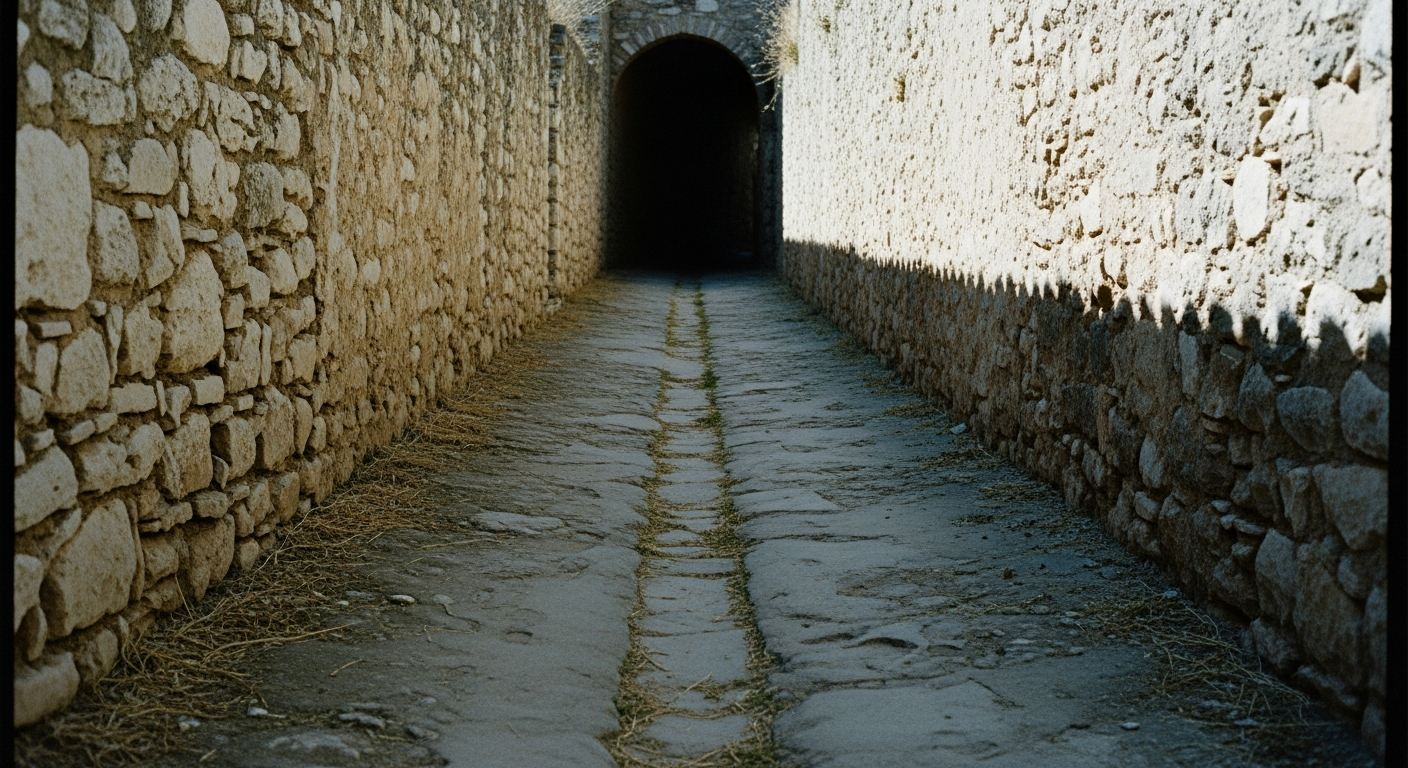
As they led him away, soldiers seized a manCulturesoldiers seized a manRoman soldiers had the legal right of angareia — compulsory impressment of civilians for state service (cf. Matthew 5:41: "if anyone forces you to go one mile"). Simon is not a follower; he is a passerby conscripted by force. Cyrene was in modern-day Libya, with a substantial Jewish diaspora community (Acts 6:9; 11:20). Mark 15:21 names Simon's sons Alexander and Rufus, suggesting they were known in early Christian communities. coming in from the countryside — Simon, from Cyrene — and forced the cross onto his shoulders. He carried it behind JesusContextHe carried it behind JesusThe Greek ὄπισθεν τοῦ Ἰησοῦ — "behind Jesus" — deliberately echoes Luke 9:23: "Let him take up his cross and follow behind me (ὀπίσω μου)." An unknowing passerby, conscripted by force, inadvertently enacts the discipleship command — while the actual disciples are nowhere to be seen..
A large crowd followed. Women were mourning and wailingCulturemourning and wailingThese women are performing formal public lament — not casual weeping but the communal mourning ritual recognized in the ancient world as an act of solidarity with the condemned (cf. Jeremiah 9:17-20). Later rabbinic tradition (b. Sanhedrin 43a) records that pious women of Jerusalem would go to mourn the executed, sometimes providing a narcotic drink to dull the pain. These are "Daughters of Jerusalem" — city residents, distinct from the Galilean women disciples who appear in 23:49 and 23:55. for him. Jesus turned to them.
"Daughters of Jerusalem, don't weep for me. Weep for yourselves. Weep for your children. The days are coming when people will say: Blessed are the barrenCultureBlessed are the barrenIn the ancient world, barrenness was the deepest social shame — a mark that many interpreted as divine punishment (cf. Elizabeth's suffering in Luke 1:25). Jesus inverts this entirely: in the coming siege of Jerusalem (AD 70), childlessness will be mercy. Josephus (Jewish War 6) describes the siege's horror in graphic detail — famine so severe that a mother consumed her own child. Those without children will be spared the worst grief.. Blessed the wombs that never boreLifeBlessed the wombs that never boreJesus' inverted beatitude is not a moral judgment on parenthood. It is a prophetic oracle about a specific historical catastrophe. Using this verse to shame or comfort childless people misapplies a text about the destruction of Jerusalem. The "blessing" of barrenness here is the blessing of being spared a particular horror — not a general teaching about fertility.. Blessed the breasts that never nursed.
"Then they'll beg the mountains: Fall on us. And the hills: Cover us. Because if they do this when the wood is green, what will happen when it's dry?"
Two others were led out with him — criminals, to be executed at his sideContextcriminals, to be executed at his sideIsaiah 53:12: "He was numbered with the transgressors." The Greek κακοῦργοι ("evildoers, criminals") is a stronger term than Mark's λῃσταί ("robbers/bandits"). These two will matter enormously in the next scene — one will mock, one will confess..
Additional Notes
-
Context Fall on us... Cover us expand_more
A direct citation of Hosea 10:8 — the language of eschatological terror, the preference for annihilation over witnessing what is coming. Revelation 6:16 reuses this exact text. The oracle belongs to the thread of Jerusalem destruction prophecies running through Luke: 13:34-35 (lament over Jerusalem), 19:41-44 (Jesus weeping over the city), 21:20-24 (the siege foretold). This is the final expression.
-
Text green wood... dry expand_more
A Jewish proverb (cf. Ezekiel 20:47) about proportionality: if this is what happens to the innocent ("green wood" — full of life), what will happen to the guilty ("dry wood" — ready to burn)? "They" likely refers to the Romans: if Rome does this to a man Pilate declared innocent, what will Rome do to a city that actually rebels? The prophecy was fulfilled in AD 70.