Luke 33-43
The Crucifixion
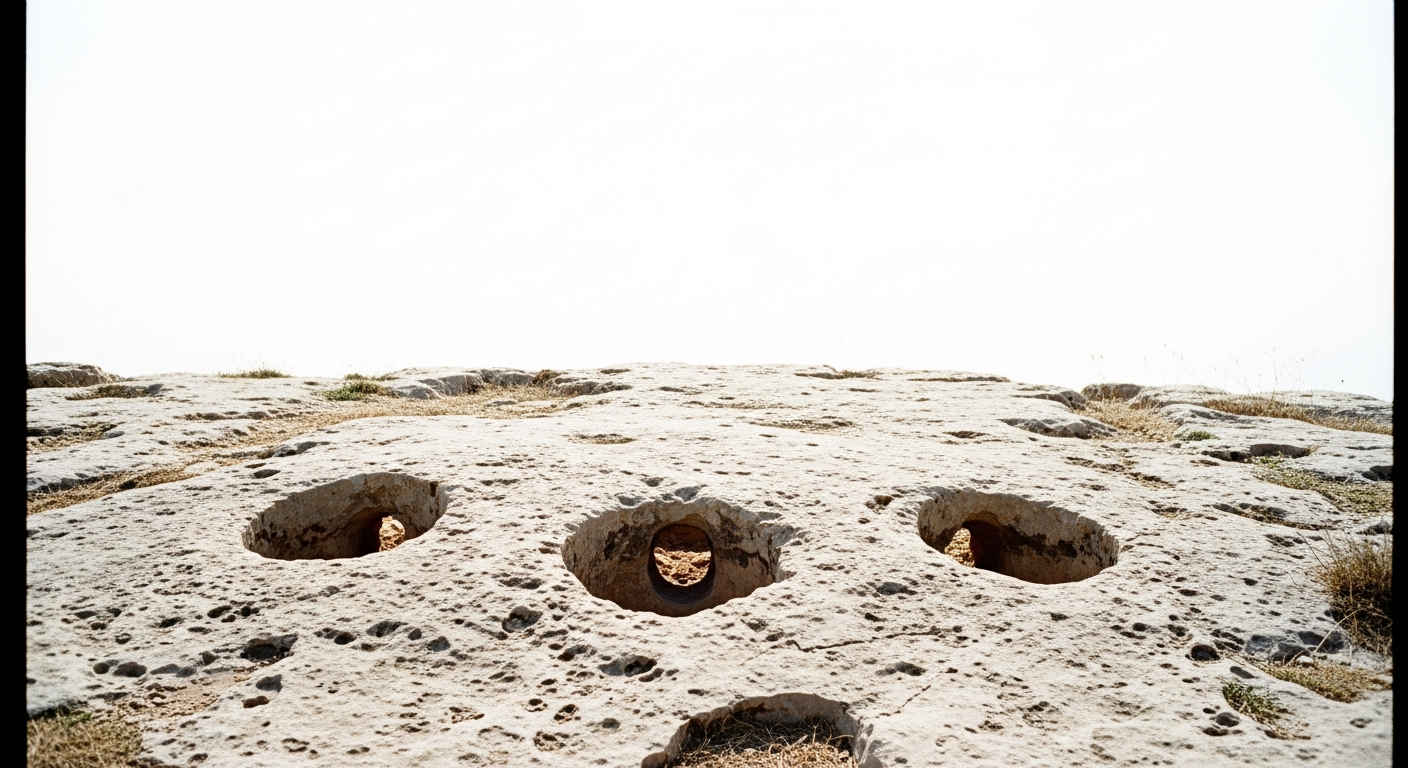
When they came to the place called the SkullCulturethe place called the SkullThe Greek Κρανίον translates the Aramaic Golgotha and the Latin Calvaria — all meaning "skull." The site is identified with high confidence as the location of the Church of the Holy Sepulchre, established by Emperor Constantine in AD 325-335 over a former limestone quarry. The only directly attested skeletal evidence of Roman crucifixion comes from the ossuary of Jehohanan (Giv'at ha-Mivtar, Jerusalem, first century CE), whose heel bone retains an iron nail — confirming the physical reality Luke narrates., they crucified himDifficultthey crucified himThe historicity of Jesus' crucifixion is one of the most secure facts in ancient history. It is attested by all four Gospels independently, by Paul (writing within 20 years of the event, 1 Corinthians 15:3-4), and by non-Christian sources: Tacitus (Annals 15.44, c. AD 116) states that "Christus" was "put to death by Pontius Pilate, procurator of Judea"; Josephus (Antiquities 18.3.3, c. AD 93) mentions "the tribe of Christians, so named from him" and his condemnation by Pilate. Even critics who dispute the resurrection accept the crucifixion as historical fact. The 1968 discovery of the Jehohanan ossuary — a crucified man's heel bone with an iron nail still embedded — provided the first direct archaeological confirmation of Roman crucifixion technique in first-century Jerusalem. there, along with the criminals — one on his right, one on his left.
And Jesus kept saying: "Father, forgive themLifeFather, forgive themForgiving someone who is actively harming you — not after the fact, not from a safe distance — is the most radical act in this chapter. Jesus does not wait for an apology. He does not wait for understanding. He prays forgiveness into the violence while it is happening. The imperfect tense (ἔλεγεν — "he kept saying") means this was not a single heroic moment but a sustained practice. Forgiveness here is not a feeling; it is an action repeated under duress.TextFather, forgive themThis verse is absent from the earliest manuscripts, including P75 (c. AD 175-225) and Codex Vaticanus, and appears in double brackets in the standard Greek text (NA28). Its authenticity remains debated. Bart Ehrman proposes that scribes removed it because they could not accept Jesus praying for Jewish people — a theologically motivated excision driven by early anti-Judaism. A 2025 Puritan Reformed Journal essay argues for authenticity from internal criteria. Whether original or very early addition, the prayer reflects ancient Christian tradition. The imperfect ἔλεγεν ("he was saying") suggests ongoing, repeated prayer during the crucifixion — not a single heroic utterance.. They don't know what they're doingContextThey don't know what they're doingThe referent of "them" is left deliberately open — the Roman soldiers casting lots (the immediate context), the Jewish leaders, or all participants. Acts 3:17 uses the same ignorance motif: "You acted in ignorance, as did your rulers." Luke frames the crucifixion as an act of ignorance rather than deliberate cosmic malice — which makes the prayer of forgiveness both generous and theologically precise.." They cast lots for his clothingContextThey cast lots for his clothingAn echo of Psalm 22:18: "They divide my clothes among them and cast lots for my garment." Crucified prisoners were stripped; their clothing became the executioners' property. Luke's spare narration — one sentence, its own paragraph — lets the detail land without commentary. The reader who knows Psalm 22 hears the echo; the reader who doesn't still feels the casual brutality..
The people stood and watched. But the rulers sneered. "He saved others — let him save himself, if he's really God's Chosen One, the Messiah." -37 The soldiers mocked him too, offering sour wine: "If you're the King of the Jews — save yourself." There was also an inscription above him: THIS IS THE KING OF THE JEWSCultureTHIS IS THE KING OF THE JEWSThe titulus crucis — a placard stating the charge — was standard Roman practice. The inscription is ironic on two levels: it states the charge as mockery, yet it is theologically true. All four Gospels preserve this inscription with minor variations, making it one of the most multiply attested details of the crucifixion..
One of the criminals hanging there kept taunting him: "Aren't you the Messiah? Save yourself. And us while you're at it."
But the other one spoke up. "Don't you fear God? We're under the same sentence he is. And we deserve it — we're getting what we earned. But this man — he's done nothing wrongContextthis man — he's done nothing wrongThe criminal's declaration is the fourth independent witness to Jesus' innocence in Luke 23: Pilate (23:4, 14, 22), Herod (by non-conviction, 23:15), the centurion (23:47), and now a dying criminal (23:41). The Greek ἄτοπον literally means "out of place, incongruous" — Jesus' punishment simply doesn't fit. A man dying for his own crimes recognizes justice in his own sentence and injustice in another's.."
Then, to Jesus — just his name, no title: "Jesus. Remember meTextJesus. Remember meThis is the only time in Luke's Gospel that someone addresses Jesus by his bare personal name — no "Lord," no "Teacher," no "Master." The intimacy is the theology: a dying man addresses another dying man by name. "Remember me" (μνήσθητί μου) echoes the lament psalms' appeal to divine memory (Psalm 25:7: "Remember me according to your steadfast love"; Psalm 106:4). This is covenant language — the appeal to God's faithful remembrance — spoken by a man who has nothing to offer except need. The criminal confesses Jesus' kingship ("your kingdom") at the moment it appears most impossible to believe. when you come into your kingdom."
And Jesus said to him: "Truly I tell you — today you will be with me in paradiseCultureparadise"Paradise" is a Persian loanword (Old Persian pairidaêza, "an enclosed garden"), entering Hebrew as pardes and Greek as παράδεισος. In Jewish Second Temple literature (2 Enoch 8-9; 4 Ezra 7:36), paradise refers to the blessed realm of the righteous dead — the dwelling of the faithful with God. The same word appears only twice more in the New Testament: 2 Corinthians 12:4 and Revelation 2:7. It is not a generic synonym for "heaven" but carries specific imagery of a garden-sanctuary where the righteous dwell in God's presence.Texttoday you will be with me in paradiseThe Greek text has no punctuation. The placement of a comma before or after "today" determines the meaning: (1) "Truly I tell you, today you will be with me in paradise" — the majority scholarly reading, adopted by virtually all major translations (NIV, ESV, NRSV, NLT, KJV). (2) "Truly I tell you today, you will be with me in paradise" — a minority reading adopted by the New World Translation and some soul-sleep traditions. In Luke, σήμερον ("today") appears 17 times and consistently functions as a salvation-present adverb modifying the action described (2:11; 4:21; 19:9). Jesus' response exceeds the criminal's request in three dimensions: today (not someday), with me (not merely remembered), in paradise (not merely the kingdom).."
Additional Notes
-
Text the people stood and watched... the rulers sneered expand_more
Luke carefully distinguishes the people (ὁ λαός) from the rulers (οἱ ἄρχοντες). The people observe silently; only the rulers mock. This distinction matters: Luke does not portray the Jewish people as a whole participating in the mockery. The title "the Chosen One" (ὁ ἐκλεκτός) is Luke's distinctive messianic designation, drawn from Isaiah 42:1 and used at the Transfiguration (9:35: "This is my Son, my Chosen One"). The rulers unknowingly speak the truth: he is God's Chosen One.
-
Life Remember me... today you will be with me expand_more
The criminal's prayer is the shortest and most desperate in the Gospels — no confession of faith, no theological argument, just a name and a request. And Jesus' response exceeds the request in every dimension: not "someday" but today; not "I'll remember" but "you'll be with me"; not a distant hope but paradise. This exchange has shaped Christian understanding of grace ever since: there is no minimum qualification for asking. No resume. No track record. The only requirement is honest need — and the willingness to voice it.