Luke 26-39
The Demon-Possessed Man
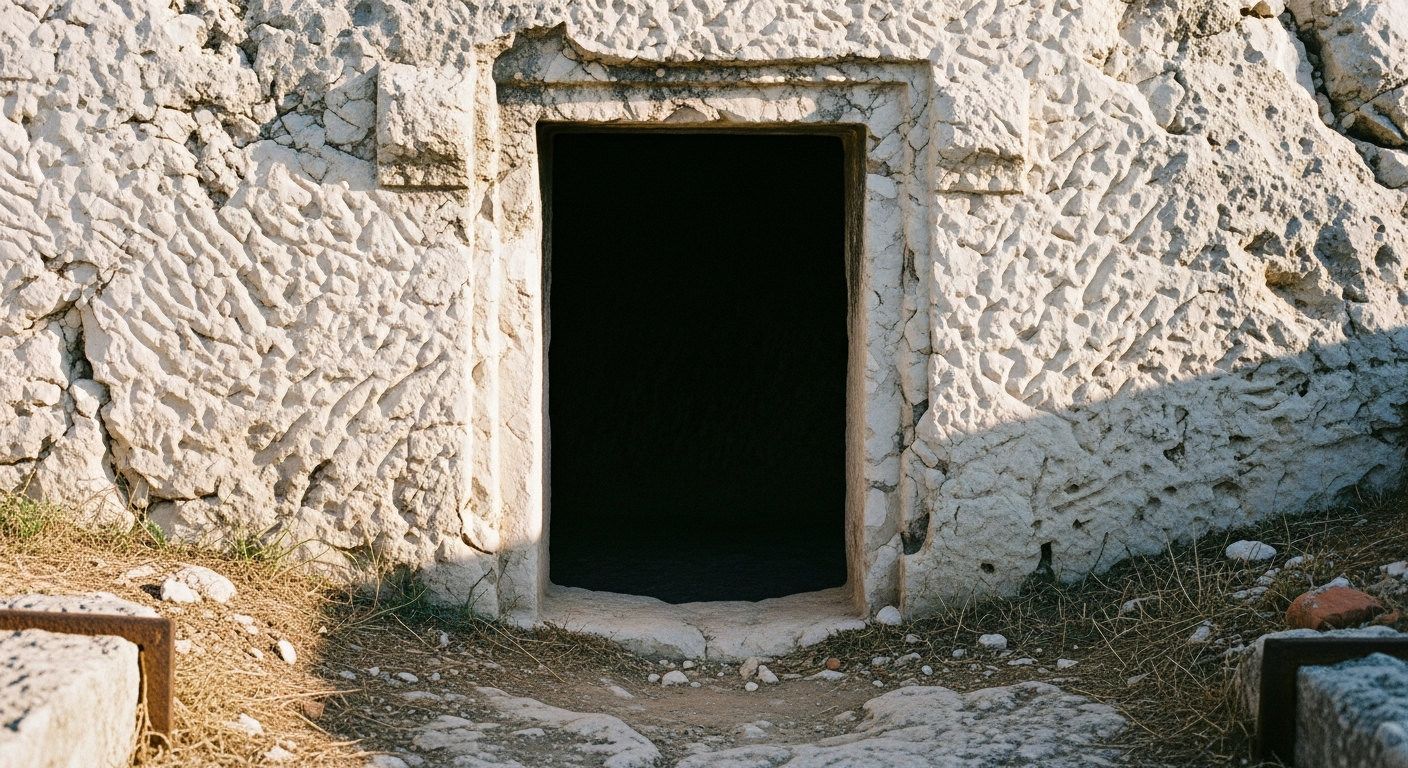
They crossed to the region of the Gerasenes, on the opposite shore from Galilee. As Jesus stepped onto land, a man came at him from the town — demon-possessed, long without clothes, living not in any house but among the tombs, among the dead.
He saw Jesus and screamed. He threw himself down and cried out, “What do you want with me, Jesus, Son of the Most High God? I beg you, don't torment me!”
Jesus had been commanding the unclean spirit to come out of him. It had seized him again and again. They had chained him, bound him, kept him under guard — but he would snap the chains and the demon would drive him back to the wastelands.
“What is your name?” Jesus asked. “LegionCultureLegionΛεγιών is a Latin loanword: a Roman military unit of approximately 5,000 soldiers. The demon names itself after the occupying imperial force — an identification that has drawn significant scholarly attention. The Roman Legio X Fretensis, stationed in the region, bore a boar emblem on its standards, creating a grim connection to the pigs that follow. Whether or not Luke intended this specific allusion, the anti-imperial resonance is unmistakable: the forces tormenting this man bear the name of the forces occupying his land. Liberation from “Legion” is liberation from every power that dehumanizes.,” the man said. Many demons had entered him.
They begged Jesus not to send them into the abyssCultureThe abyss (ἄβυσσος)In Jewish cosmology, the abyss was the place of ultimate imprisonment — the cosmic deep beneath the earth where fallen powers are confined (1 Enoch 10:4-6, Revelation 9:1-2, 20:1-3). The demons beg not for mercy but for a lesser punishment: anything but the abyss. Their terror reveals the geography of the unseen world as first-century Jews understood it — a cosmos with layers, where some places are worse than others, and where even demons know their final destination.. There was a large herd of pigsCulturePigsPigs were the paradigmatic unclean animal in Jewish law (Lev. 11:7, Deut. 14:8). Their presence confirms Gentile territory — no Jewish community would raise them. The scene layers uncleanness upon uncleanness: demons, tombs (death contamination), nakedness (shame), and now pigs. Jesus enters the most impure space imaginable — and his authority extends even here. The destruction of the herd raises an uncomfortable question the text does not answer: was the economic cost to the community justified by one man's liberation? feeding on the hillside, and the demons begged to be allowed into the pigs. He let them. They came out of the man and entered the pigs, and the whole herd stampeded down the steep bank into the lake. They drowned.
The herders fled. They told everyone in the town and countryside what had happened. People came to see for themselves. They found the man sitting at Jesus' feet — clothed, calm, in his right mind. And they were afraid. Witnesses told them how the man had been saved. But the whole population of the region asked Jesus to leave. They were all afraid. He got into the boat and turned back.
The man begged to go with him. Jesus said, “Go home. Tell them what God has done for you.”
He went through the entire town, telling everyone what Jesus had done for him.
Additional Notes
-
Difficult Demons and diagnosis expand_more
Three frames: (1) Psychiatric: the man's symptoms — social isolation, self-harm, extreme agitation, superhuman strength during episodes, altered identity — correspond to recognizable conditions in modern psychiatry. Ancient cultures lacked diagnostic categories; “demon possession” was the available framework for severe mental illness. The healing may represent a therapeutic encounter. (2) Spiritual: the ancient world understood spiritual forces as real agents with power over human lives. The detailed interaction — naming, negotiation, transfer — follows established exorcism patterns and reflects a worldview where human suffering has cosmic dimensions. Reducing this to psychiatry may miss the text's deeper claim about forces that dehumanize. (3) Both/and: some contemporary readers hold that spiritual and psychological realities are not mutually exclusive — that the language of “demons” names something real about destructive forces, whether understood as external beings or internal patterns. The text is more interested in the result than the mechanism: a man restored to clothing, community, and coherence.
-
Context God and Jesus expand_more
Notice the shift: Jesus tells the man to proclaim “what God has done for you” (ὅσα σοι ἐποίησεν ὁ θεός). The man goes and proclaims “what Jesus had done for him” (ὅσα ἐποίησεν αὐτῷ ὁ Ἰησοῦς). Luke does not correct this. The equation is deliberate: what God does and what Jesus does are, for Luke, the same thing. This is christology by narrative structure rather than theological statement — the most characteristically Lukan way of making the highest possible claim.