Luke 1-9
Repent or Perish
Someone brought the news: Galileans— worshippers, pilgrims — whose blood Pilate had mixed with the blood of their sacrifices.Right there on the Temple floor.
Jesus turned to the crowd. "Do you think those Galileans were worse sinnersCultureworse sinnersThe assumption Jesus names — disaster proves guilt — was the default theological framework of the ancient world. Job's friends articulated it: suffering means God is punishing. The crowd brings the news to Jesus as a test case, expecting a prophetic verdict. Jesus refuses the entire framework, twice. than everyone else in Galilee? That they suffered because they deserved it?"
He let the question land. "No. I tell you — unless you turnTextturn (μετανοέω)The Greek word metanoeō means literally "to change direction" — a turning of the whole person toward a new path, not primarily an expression of remorse. The traditional English "repent" imports a guilt-laden, backward-looking emotional register that obscures the forward-facing summons. Jesus is not demanding self-accusation but course correction., you will all perish in the same wayCultureperish in the same wayJesus is not threatening divine punishment. He is naming historical consequence — the political and spiritual trajectory his audience is on. Within forty years, the Roman legions would destroy Jerusalem and the Temple (70 CE). The "likewise" (ὁμοίως) points to the manner of death — sudden, violent — not to the reasons. The same logic Jesus just refused (disaster = divine punishment) must not be reintroduced through his own words.."
"Or those eighteen in Jerusalem — the ones crushed when the tower of SiloamCulturetower of SiloamThe Tower of Siloam was located near the Pool of Siloam, south of Jerusalem — possibly part of an aqueduct construction project. Jesus deliberately pairs political violence (Pilate's massacre of worshippers) with a random construction accident (a tower collapsing on workers). The pairing dismantles any theodicy logic: if neither political atrocity nor random accident proves divine punishment, then the entire framework is broken. The Greek word opheiletai (rendered "more guilty") means literally "debtors" — people who owed a debt to God. Jesus refuses to classify disaster victims as people who "deserved" what happened. collapsed on them. Do you think they were more guilty than everyone else in the city?" "No. I tell you — unless you turn, you will all perish in the same way."
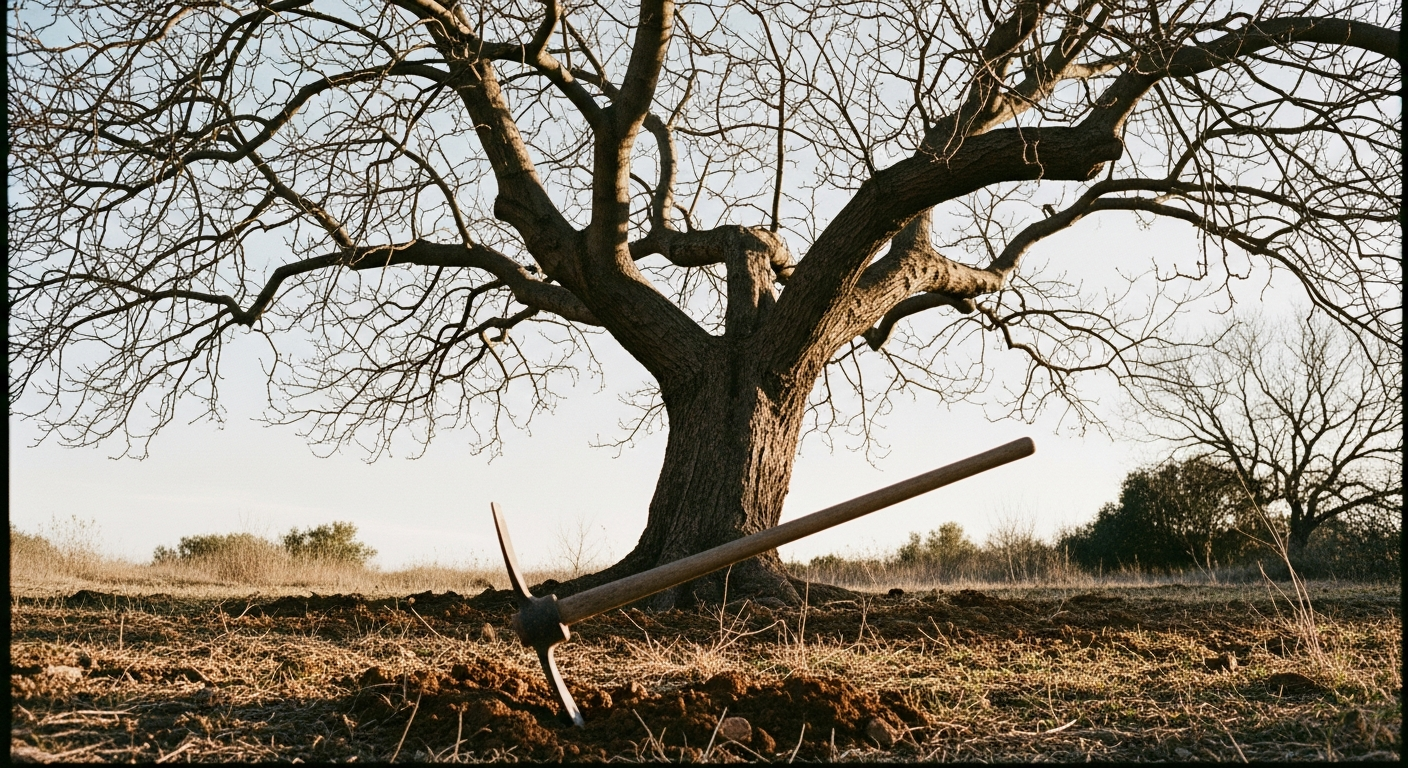
Then he told a parable. "A man had a fig tree planted in his vineyard. Year after year he came looking for fruit. Three years — nothing.
Finally he said to his gardener, 'Cut it down. Why should it go on exhausting the soil?'
"But the gardener said, 'Sir — leave it one more yearLifeleave it one more yearThe gardener does not argue theology with the vineyard owner. He does not debate whether the tree deserves another chance. He offers his own labor: let me dig, let me fertilize, let me do the work. Advocacy that changes things is rarely eloquent — it is patient, physical, unglamorous. The gardener's posture — kneeling in the dirt, hands in the manure, interceding through labor rather than speech — is a model of what it looks like to stay with someone who has not yet borne fruit. Not just waiting, but actively tending. For one more season.. Let me dig around it and spread manureTextdig around it and spread manure (κόπρια)The Greek word kopria means animal dung — manure, not "fertilizer." The earthiness is the point. This is what mercy looks like in the parable: not clean or theological but agricultural labor. A gardener on his knees in the dirt, digging around roots, spreading dung. Cyril of Alexandria read the gardener as Christ himself, interceding before the Father. If so, divine grace comes in the form of the most humble, physical work — the smell of the soil, the patience of seasons.. If it bears fruit next year—TextIf it bears fruit next year—The parable ends without resolution. The gardener's speech breaks off mid-sentence: "If it bears fruit — well and good. But if not, then cut it down." The conditional hangs in the air. Ancient parable listeners expected this: the unfinished ending forces the listener to complete the story for themselves. The tree is neither saved nor cut. It hangs between the axe and another season. The invitation is open but not indefinite — the "until" marks a temporal limit.'"
Additional Notes
-
Culture Galileans whose blood Pilate mixed with their sacrifices expand_more
No record of this specific atrocity survives in Josephus, but it is entirely consistent with Pilate's documented brutality — he had soldiers beat protestors, infiltrated crowds with concealed daggers, and provoked violence through deliberate provocation. That Roman soldiers killed Jewish pilgrims during the act of sacrifice, so that human blood mingled with sacrificial blood on the Temple floor, represents an ultimate desecration — violence in the holiest space, during the holiest act.
-
Difficult Galileans whose blood Pilate mixed expand_more
Luke's account of this atrocity, though not directly attested in Josephus, is confirmed as historically plausible by multiple converging lines of evidence. Josephus documents at least three separate instances of Pilate's extreme brutality: the aqueduct massacre where soldiers with concealed clubs beat and killed Jewish protestors (Antiquities 18.60-62), the incident of smuggling military standards into Jerusalem to provoke confrontation, and the massacre of Samaritans at Mount Gerizim (Antiquities 18.85-89) that eventually led to his removal from office. The detail that blood mixed with sacrificial blood places the event during a festival when non-priests brought their own animals — exactly when Pilate would have stationed troops in Jerusalem. Archaeological confirmation of the Pool of Siloam (mentioned in 13:4), excavated by Eli Shukron and Ronny Reich beginning in 2004, adds further credibility to Luke's knowledge of Jerusalem's topography.
-
Life unless you turn expand_more
The first instinct when tragedy strikes is to ask why — and the second is to find someone to blame. Jesus refuses both moves and redirects: instead of decoding the victims' guilt, examine the direction of the one still standing. This is not about guilt. It is about orientation. The Desert Fathers called this metanoia: not self-punishment but a turning of the whole self toward what matters. When bad news arrives, the question is not "what did they do wrong?" but "what am I doing with the time I have?"
-
Difficult disaster and divine punishment expand_more
This passage directly addresses one of the oldest and most persistent theological claims: that natural disasters, accidents, and political violence are divine punishment for the victims' sins. Three perspectives. First, critical-historical: Jesus dismantles the retribution theology that dominated Second Temple Judaism (and that persists in many traditions). He pairs two utterly different events — political massacre and construction accident — and declares neither proves guilt. Second, theological: Jesus relocates responsibility from the victims to the audience. The question is not "why did they suffer?" but "what are you doing?" The redirect from theodicy to ethics is the passage's radical move. Third, contemporary: this logic resurfaces after every disaster — Hurricane Katrina blamed on New Orleans' immorality, earthquakes attributed to God's wrath against specific populations. Jesus refuses this reasoning as firmly as any modern ethicist, but from within the prophetic tradition.
-
Context fig tree in his vineyard expand_more
In the Hebrew prophets, both the fig tree and the vineyard are images for Israel's relationship with God. The fig tree appears in Jeremiah 8:13 ("I will take away their harvest... there will be no figs on the tree"), Hosea 9:10 ("Like finding grapes in the wilderness, I found Israel... like the first fruit on the fig tree"), and Micah 7:1. The vineyard is Isaiah 5:1-7's great Song of the Vineyard, where God plants a vineyard (Israel), cultivates it, and is devastated when it produces only wild grapes. A fig tree inside a vineyard is a double prophetic symbol: Israel's fruitfulness on trial.