Luke 31-35
Lament Over Jerusalem
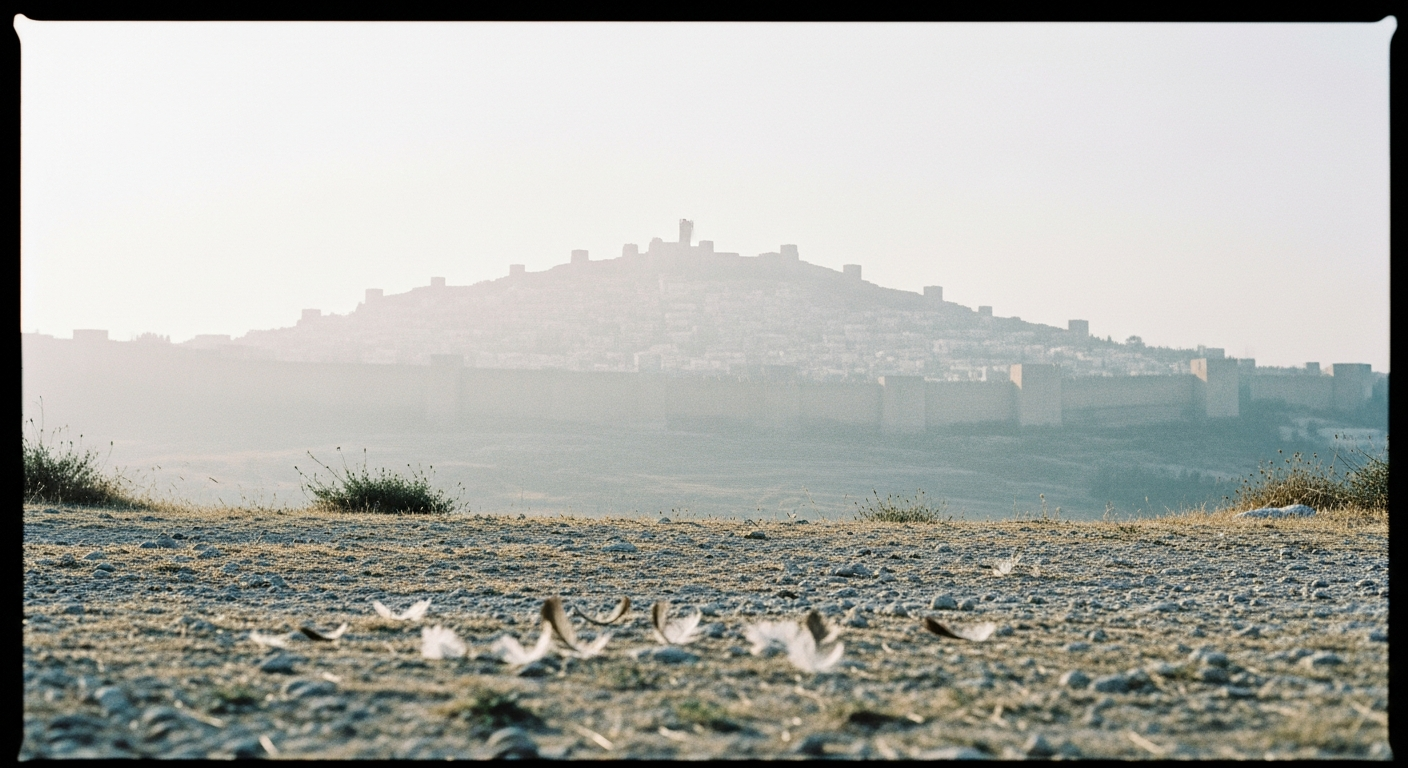
At that very hour, some Pharisees came to him.Not to challenge him — to warn him. "Get out of here. Leave. Herod wants to kill you."
Jesus looked at them. "Go and tell that foxTextthat fox (τῇ ἀλώπεκι ταύτῃ)In Jewish tradition, the fox — in contrast to the lion — represents cunning but lesser, scavenging power. This is not a backhanded compliment. It is a dismissive insult: Jesus is calling Herod Antipas a minor, unprincipled schemer who cannot stop what God has set in motion. The demonstrative "that" (ταύτῃ) adds contempt.: I am casting out demons and completing healings today and tomorrow, and on the third day my work will be finishedTexton the third day my work will be finished (τελειοῦμαι)"Today and tomorrow and the third day" is a Semitic idiom meaning "in a short while" — not a literal three-day count and not a veiled resurrection prediction. The verb teleioumai means "I am brought to completion" — the same word used for finishing a course (Acts 20:24) or completing a task (Luke 2:43). Jesus is saying: my mission continues on its appointed course for a short while yet, and then it will be complete. The BDAG lexicon confirms this is idiomatic temporal language.. But I must keep going today, and tomorrow, and the day after — because it is not possible for a prophet to perish outside Jerusalem."
The sentence hung in the air — grim, precise, inevitable. "Jerusalem, Jerusalem." His voice broke open. "You who kill the prophets and stone those sent to you — how often I have wanted to gather your children the way a henTexta hen (ὄρνις)The Greek word ornis here means specifically a domestic hen — not a generic bird or an eagle. Jesus applies to himself the divine image of gathering under wings (Psalm 91:4; Deuteronomy 32:11; Psalm 17:8; 36:7; 57:1; 61:4; 63:7) using a specifically maternal, domestic, vulnerable image. The hen does not overpower the threat to her chicks. She covers them with her own body. This is one of the most striking images in the Gospels: Jesus claiming a divine prerogative through a feminine, self-sacrificing image. gathers her chicks under her wings." He stopped. "And you were not willingTextyou were not willing (οὐκ ἠθελήσατε)The Greek word thelō means "to will, to want, to be willing." Jerusalem's refusal was a refusal of will, not an inability. This distinction carries enormous theological weight: divine love extended; human agency declined. The Hebrew Bible is full of this pattern — divine invitation met by human refusal (Isaiah 65:2; Hosea 11:1-7). The tragedy is not that Jerusalem could not respond but that it chose not to.."
"Your house is left to you desolateTextyour house is left to you desolateThe language echoes Jeremiah 12:7 ("I have forsaken my house, I have abandoned my heritage") and Jeremiah 22:5. This is the vocabulary of divine withdrawal — God's presence departing — not of God's fist destroying. The "house" is the Temple, or at most the city of Jerusalem addressed in its leadership role. This is prophetic lament, not triumphant condemnation: a prophet grieving over what his own people will suffer..But I tell you: you will not see me until the time comes when you say, 'Blessed is the one who comes in the name of the LordContextBlessed is the one who comes in the name of the LordPsalm 118:26 — a processional psalm sung during pilgrimage festivals, especially at Passover. The crowd will shout these exact words when Jesus enters Jerusalem (Luke 19:38). The word "until" (heōs) is the hinge between lament and hope: the desolation does not end in permanent rejection but in the expectation that the day of recognition is still coming. The last word of the chapter is not grief but an open door..'"
Additional Notes
-
Culture some Pharisees came to warn him expand_more
Luke's portrait of the Pharisees is more complex than many readers expect. In this scene, Pharisees come not as antagonists but as concerned protectors warning Jesus about a genuine death threat. Luke records Pharisees who invite Jesus to dinner (7:36; 11:37; 14:1), Pharisees who debate him respectfully (13:31), and Pharisees who later become believers (Acts 15:5; 23:6-9). Reducing Pharisees to cardboard villains flattens the text and feeds the anti-Jewish reading that has caused immense historical harm.
-
Difficult Pharisees came to warn him expand_more
The historical complexity of Jesus' relationship with the Pharisees is one of the strongest internal arguments for the Gospels' reliability. A fabricated narrative would present enemies as uniformly hostile. Instead, Luke preserves a multi-dimensional portrait: Pharisees who oppose Jesus (11:53-54), Pharisees who invite him to dinner three times (7:36; 11:37; 14:1), Pharisees who protect him from Herod (13:31), and Pharisees who later become Christians (Acts 15:5; 23:6-9). Paul himself was a Pharisee (Philippians 3:5). This range of interaction — from debate to protection to conversion — reflects the historical reality of a diverse movement, not the literary convenience of stock villains. The scholar E.P. Sanders and the work of the "New Perspective on Paul" have confirmed the Pharisees as serious, devout teachers whose legal debates with Jesus operated within the normal range of Jewish intra-community discussion.
-
Life the way a hen gathers her chicks expand_more
Jesus reaches for the most vulnerable image available: not an eagle, not a lion, not a warrior — a hen. The hen does not overpower the threat. She covers her chicks with her own body. This is one of the most striking moments in the Gospels: divine protection reimagined as maternal vulnerability, shelter offered through self-exposure. The image says something about how love actually works — not by defeating the threat from a distance, but by placing yourself between the danger and the ones you are trying to protect. And the devastating final line: "you were not willing." Love that gathers can be refused. Protection that is offered can be declined. The wings stay open.
-
Difficult "your house is left desolate" — harm history expand_more
This verse has been used across centuries to claim God's permanent rejection of the Jewish people — one of the most consequential misreadings in the history of biblical interpretation. This reading is exegetically unjustifiable for three reasons. First: Jesus speaks as a prophet from within the Jewish tradition, addressing Jerusalem's leadership in a specific historical moment, not all Jewish people at all times. Second: the "until" clause (ἕως) explicitly preserves hope — the desolation is provisional, not permanent, conditioned on a future recognition. Third: the quotation "Blessed is the one who comes in the name of the Lord" is Psalm 118:26, sung at Passover, and the crowd will sing these exact words at the Triumphal Entry (19:38). The final word of the chapter is not condemnation but expectation.